

High-Low Percent
A breadth indicator that measures the percentage of net new highs within a particular group, such as a SPDR or index ETF.
What Is the High-Low Percent?
A breadth indicator that calculates the proportion of net new highs is the High-Low Percent. StockCharts.com computes this indicator for the nine sector SPDRs and several indexes following the market close. The High-Low Line can be made using the High-Low Percent or plotted separately. The study of the underlying security can then be enhanced by these signs. For instance, the study of XLK would be enhanced by the High-Low Line based on the High-Low Percent for the Technology SPDR (XLK). This post will provide examples of SharpChart and explain how to utilize this indicator. A sample list of symbols is provided at the conclusion of this article.
Calculating the High-Low Percent
High-Low Percent data spanning at least three years is available on StockCharts.com. However, keep in mind that these computations rely on the list of companies in the exchange-traded fund (ETF) or underlying index, like XLK, which is subject to change. This indicates that the two-year-old breadth data is predicated on the holdings that were in place at the time, which can differ from the holdings that are in place now. Chartists should take this into account when using a long-term chart, even though the holdings for the nine sector SPDRs and indexes are comparatively constant. A copy
High-Low Percent = (52-week Highs Less 52-week Lows)/ Total Issues
High-Low Percent = (15  -  2) / 77 = +13/77 = +16.88%
High-Low Percent = (2  -  6) / 77 = -4/77 = -5.19%
The High-Low Percent ranges from -100% to +100%, with zero serving as the midpoint. In actuality, the range is significantly lower, with extreme readings—greater than +70% and less than -70%—being quite uncommon.
The Technology SPDR contains 77 stocks with 15 new highs and two new lows in the numerical illustration above. Since there have been more new highs than new lows, the High-Low Percent is positive (+16.88%). Two new highs and six new lows may be found in the second sample. Since there are more new lows than new highs, the High-Low Percent is negative (-5.19%).
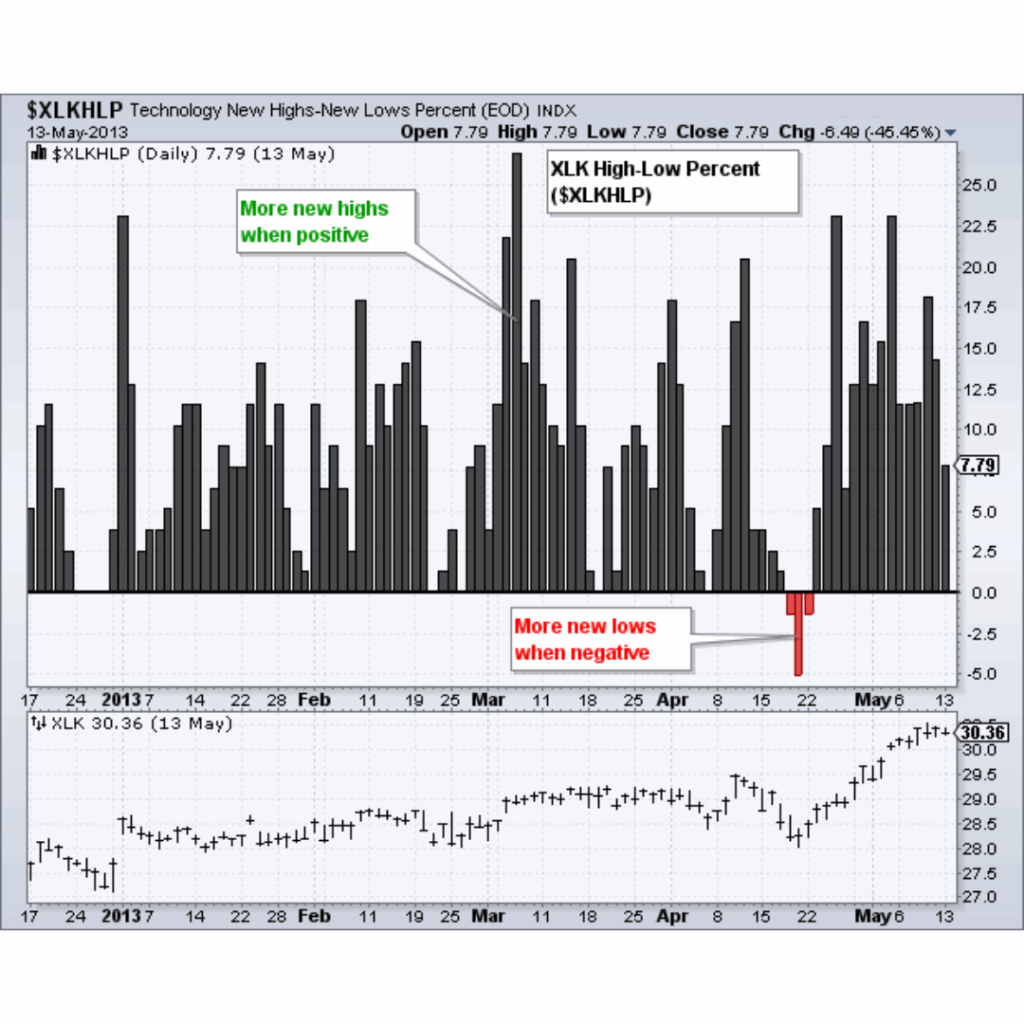
High-Low Percent – Chart 1
Interpreting the High-Low Percent
High-Low Percent is a lagging indicator that serves as a breadth indicator, aiding in the definition of the medium- to long-term trend. 52 weeks pass before a new peak or low is achieved. Following a prolonged increase in the S&P 500, new highs are formed and hold firm for as long as the upward trend continues. It is doubtful that there would be a spike in new lows within a few weeks, but new highs might dry up with the initial downturn or sideways consolidation. An extension of new lows requires a significant support break or a prolonged downturn. To find turning points, chartists can draw a High-Low Line or use the High-Low Percent as a stand-alone signal.
High-Low Line
The High-Low Line is a cumulative measure of each period’s High-Low Percent value. The High-Low Line rises when High-Low Percent is positive and falls when High-Low Percent is negative. The values on the right-hand scale are not important because these values depend on the starting date. Chartists should simply focus on the line’s movements and general direction. It is also possible to apply a moving average or other indicators to the High-Low Line.
The chart below shows the XLE High-Low Line with a 20-day EMA in the main window and the Energy SPDR (XLE) in the lower window. As noted above, High-Low Percent is a lagging indicator that usually turns after the trend has turned. Some signals will be timely and result in good trades, but others will lag and produce whipsaws if a trend quickly reverses
.
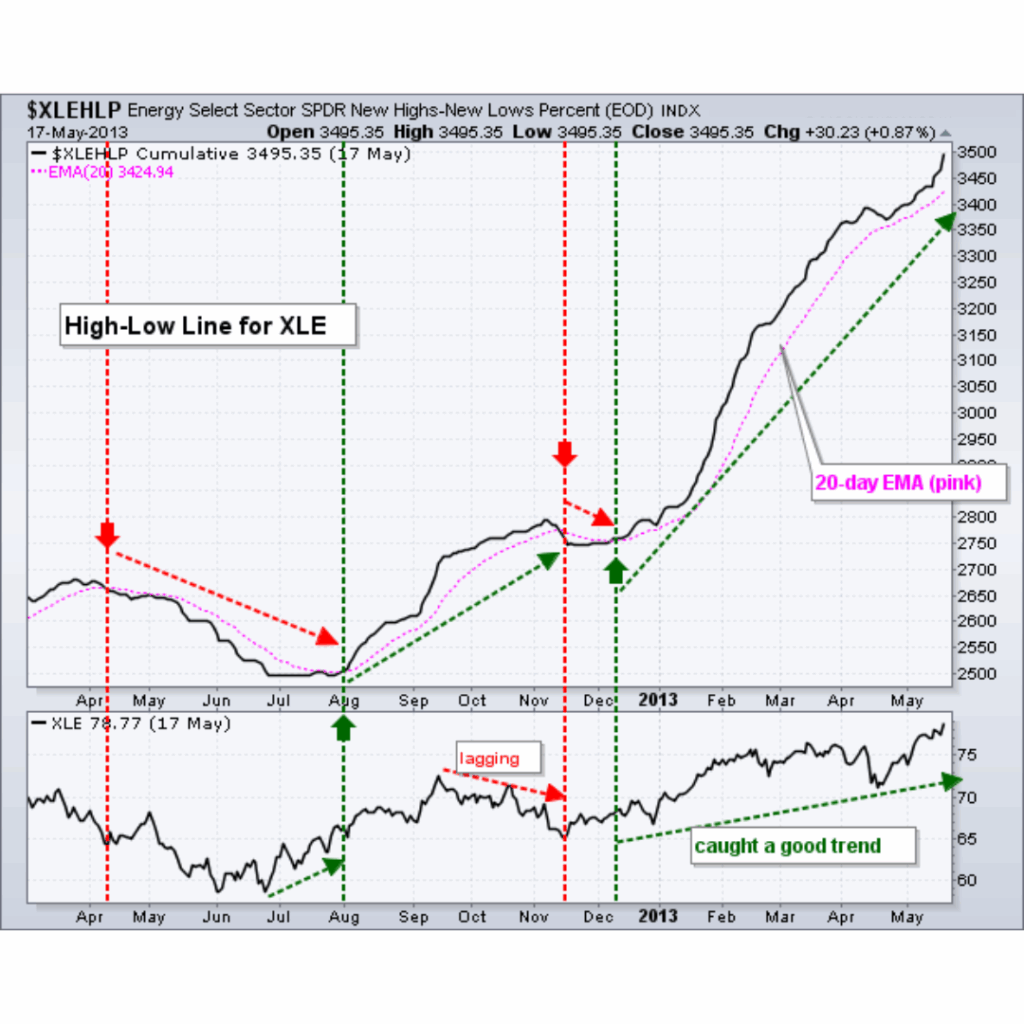
High-Low Percent – Chart 2
Let’s examine a few of the indicators. First, notice how the High-Low Line declined from early April to late June before then flattening out. XLE turned up in July, but the High-Low Line did not turn up and break its 20-day EMA until August 1st. Second, XLE then turned down in October and the High-Low Line followed with a downturn in mid-November (lagging). This downturn did not last long as the High-Low Line turned back up in mid-December. Third, notice that the December upturn lasted more than six months as the indicator caught a good trend.
High-Low Percent
Chartists can also plot High-Low Percent as an indicator on its own. The chart below shows High-Low Percent for the Utilities SPDR (XLU) in the main window and XLU in the lower window. Notice how High-Low Percent fluctuates between -15% and +72%. This range is large because utilities are a rather homogeneous group and XLU has less than 40 stocks.
Click here for a live version of the chart.
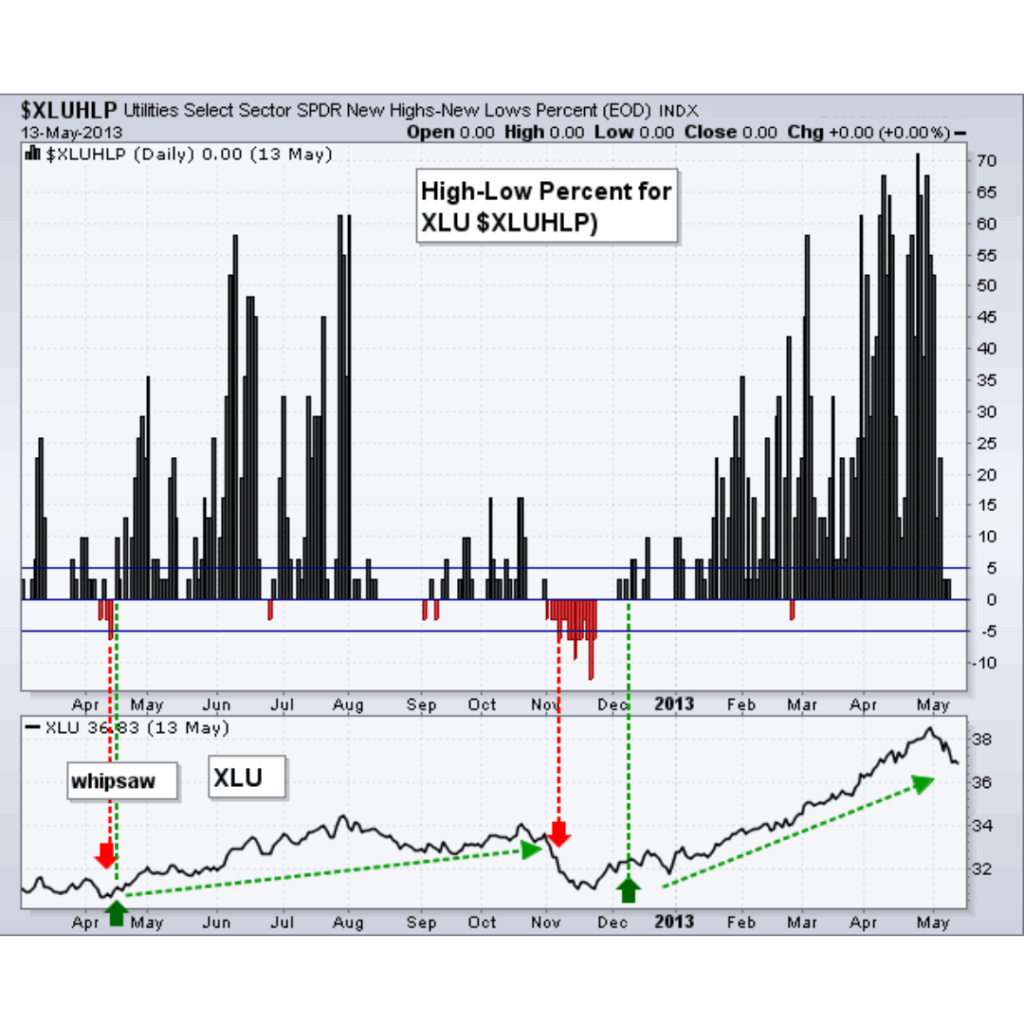
High-Low Percent – Chart 3
Chartists can employ a bullish/bearish threshold or search for crossovers above/below the zero line to determine their trading bias. In this case, a move below -5% is considered bearish, whereas a rise above 5% is considered bullish. The quantity of signals and whipsaws is decreased by these thresholds. When a strong trend appears, signals appear wonderful, but because of the lag, there will also be late signals. When utilizing High-Low Percent, bear this in mind.
The Bottom Line
Chartists can use the High-Low Percent breadth indicator to pinpoint trend shifts or the path of least resistance. In its most basic form, when there are more new highs than new lows, the path of least resistance is up. When there are more new lows than new highs, the path is down. Keep in mind that the High-Low Percent is a lagging indicator, meaning that changes in it typically occur after the underlying index or ETF trend has turned around.
SharpCharts
Any SharpChart can have High-Low Percent added by using the relevant symbol (see list below). By choosing “cumulative” as the chart type, chartists can quickly build a High-Low Line. The underlying security (XLK) can be displayed in a window above or below the main chart window, and a moving average can be added as a “overlay.”

High-Low Percent – Chart 4
By using this option in the Chart Attributes/Type section, the High-Low Percent can be displayed independently as a “histogram.” This facilitates the analysis of the fluctuations and the visualization of the zero line. Chartists can display the underlying security in the window above or below the main window by adding horizontal lines using the “overlays” section.

High-Low Percent – Chart 5