

A technical indicator provides an alternative viewpoint for examining the price movement. Some, like moving averages, have comparatively simple physics and are derived from basic mathematics. Others, like stochastics, have intricate formulas that take more research to completely comprehend and value. Technical indicators can offer a distinct viewpoint on the direction and strength of the underlying price action, regardless of how complicated the calculation is.
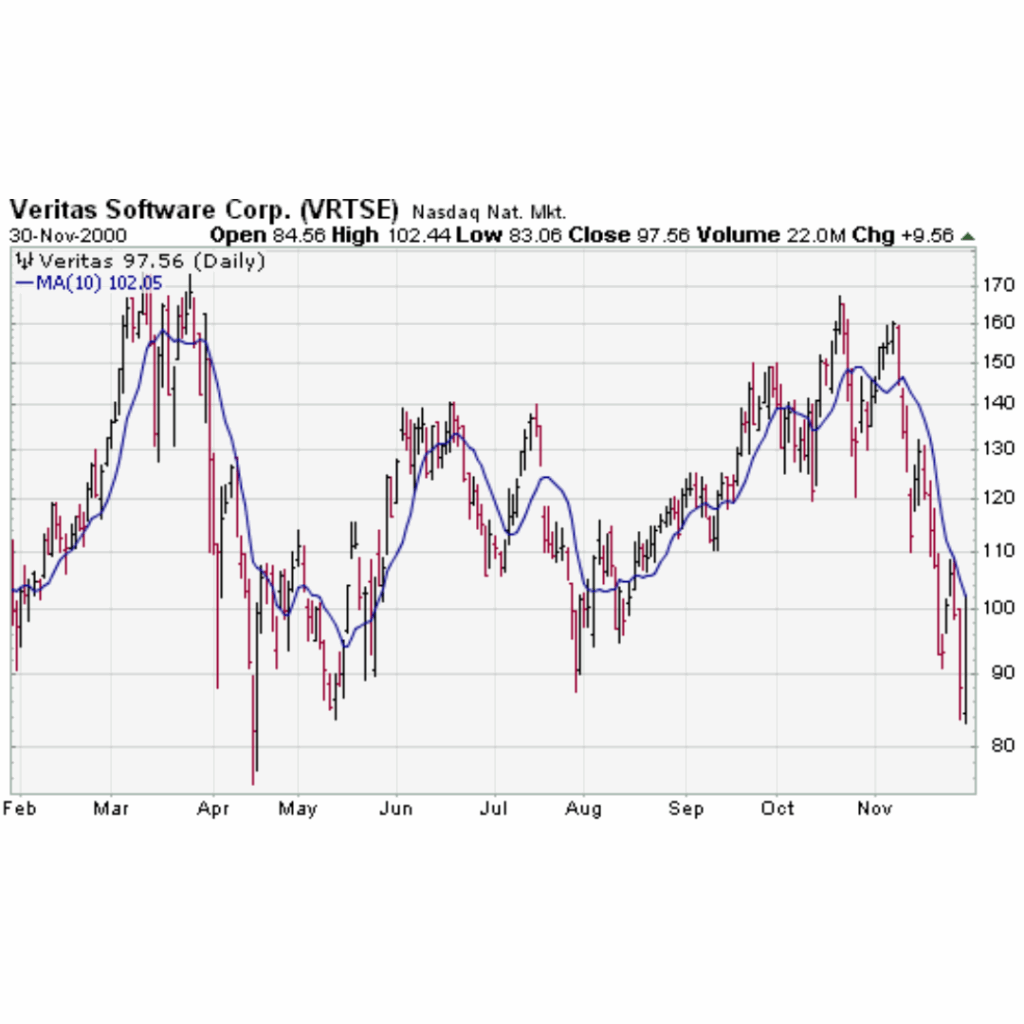
An indicator known as a simple moving average determines the average price of a securities over a predetermined number of time periods. The data will be smoothed by a moving average if a security is very volatile. By eliminating random noise, a moving average provides a more consistent view of the price activity. Given how volatile Veritas (VRTSE) is, an analyst might find it challenging to identify a trend. Random fluctuations are smoothed down to make it simpler to spot a trend by applying a 10-day simple moving average to the price movement.
Why Use Indicators?
Indicators serve three broad functions: to alert, to confirm and to predict.
- An indicator can act as an alert to study price action a little more closely. If momentum is waning, it may be a signal to watch for a break of support. Alternatively, if there is a large positive divergence building, it may serve as an alert to watch for a resistance breakout.
- Indicators can be used to confirm other technical analysis tools. If there is a breakout on the price chart, a corresponding moving average crossover could serve to confirm the breakout. If a stock breaks support, a corresponding low in the On-Balance-Volume (OBV) could serve to confirm the weakness.
- According to some investors and traders, indicators can be used to predict the direction of future prices.
Tips for Using Indicators
Indicators show. This may seem simple, yet occasionally traders only pay attention to an indicator and disregard a security’s price action. Indicators use formulae to filter price action. They are therefore derivatives rather than accurate representations of the price action. When using analysis, this should be taken into account. The price activity should always be considered while analyzing an indication. What does the indicator tell us about a security’s price action? Is there a strengthening of the price action? Weaker?
Indicators should be used in conjunction with other technical analysis tools, even if it may be clear when they produce buy and sell indications. Even while an indicator flashes a buy signal, it could not be a real one if the chart pattern displays a descending triangle with a string of falling peaks.
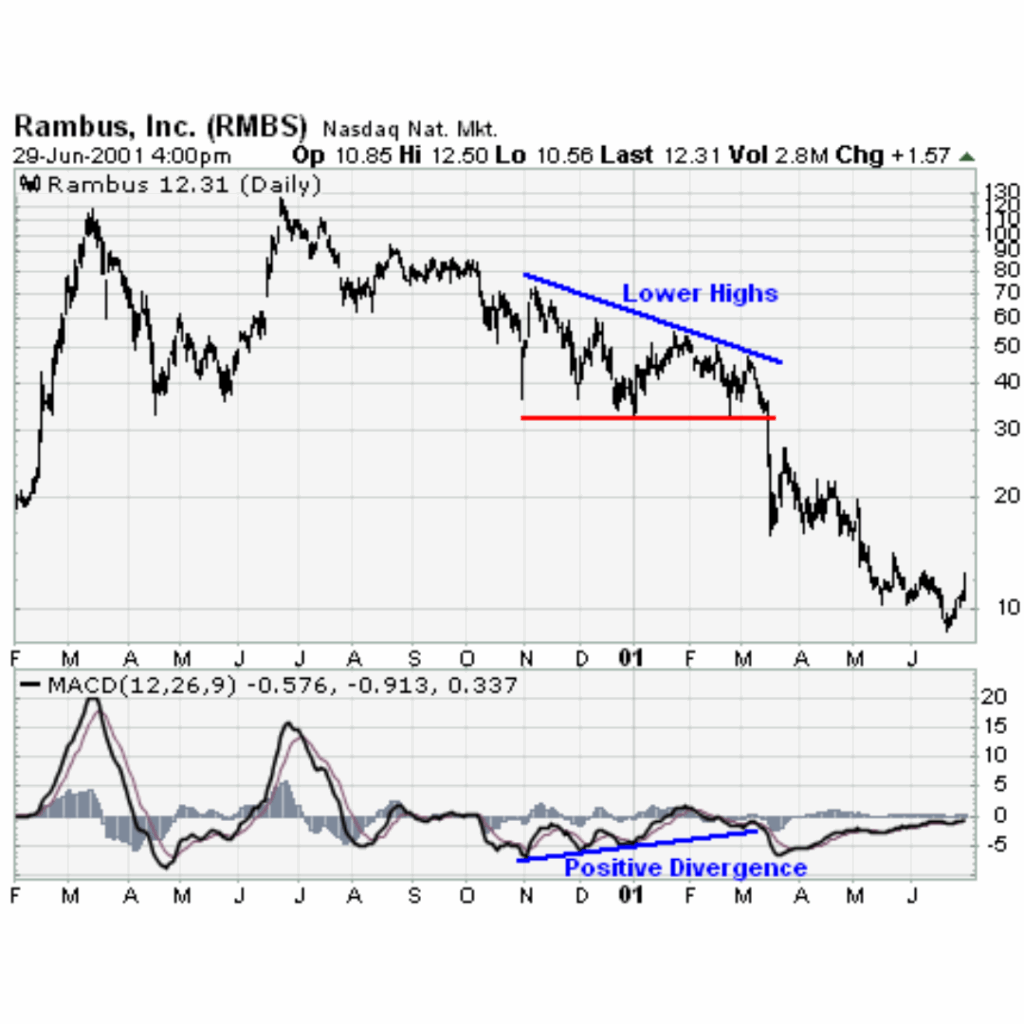
The MACD formed a positive divergence in the chart below, improving from November to March. The stock did not surpass its prior response high or break over the resistance, although having all the signs of a MACD buying opportunity. The stock’s lack of confirmation ought to have been a red flag against taking a long position. For the record, on March 1, the stock broke support from the descending triangle, indicating a sell signal.
Reading indications is more of an art than a science, as is always the case in technical analysis. When used on several equities, the same indicator may display distinct behavioral tendencies. Delta Airlines may not see the same results from indicators that are effective for IBM. Over time, proficiency with the different indicators will be developed via meticulous research and analysis. As this expertise develops, certain nuances, as well as favorite setups, will become clear.
Today, hundreds of indicators are in use, and new ones are developed on a weekly basis. Numerous indications are pre-installed in technical analysis software applications, and users can even design their own. Selecting an indication to follow might be difficult because of the amount of buzz around them. Only a small number of the hundreds of new indicators that have been introduced truly provide a unique viewpoint and merit consideration. It’s interesting to note that the signs that have endured the longest are typically the ones that deserve the greatest attention.
Use caution and moderation when selecting an indication for analysis. It is usually pointless to try to cover more than five indicators; instead, concentrate on two or three and become well-versed in their nuances. Instead of selecting indicators that move in concert and produce identical signals, try to select indicators that enhance one another. For instance, using two indicators like the RSI and stochastics, which are useful for displaying oversold and overbought levels, would be redundant. Both of these indicators have overbought/oversold thresholds and track momentum.
IN PART 2 WE CAN LEARN ABOUT ABOUT LEADING INDICATORS
you may be interested in this blog here: