Read more about the article Strengths of Fundamental Analysis
Explore how fundamental analysis uncovers a company’s true value using financial health, earnings, and economic data.

Strengths of Fundamental Analysis

Strengths of Fundamental Analysis Long-term Trends For long-term investments based on extremely long-term patterns, fundamental analysis works well. Patient investors who choose the appropriate sector groups or companies can gain from the ability to see and forecast long-term changes in the economy, population, technology, or consumer behavior. Learn more about this Value Spotting Finding businesses that offer high value will be made easier with the aid of sound basic analysis. Some of the most renowned investors have a long-term and value-oriented perspective. John Neff, Warren Buffett, and Graham and Dodd are regarded as value investing evangelists. Companies with significant assets, a solid balance sheet, consistent earnings, and longevity can be found with the aid of fundamental research. Business Acumen One of the most obvious, but less tangible, rewards of…

Continue ReadingStrengths of Fundamental Analysis
Read more about the article What is Lagging Indicators
📉 What Are Lagging Indicators? Lagging indicators help confirm trends after they form, giving you reliable entry and exit signals. 📊 Learn when to use them with smart trading strategies at www.investmentiq.in #LaggingIndicators #StockMarketEducation #TechnicalAnalysis #investmentiQ #SmartTrading

What is Lagging Indicators

Lagging indicators, often known as trend-following indicators, do exactly what their name suggests: they track the price activity. These signs will almost never drive a security's price. When stocks or markets exhibit robust trends, trend-following indicators perform well. As long as the trend continues, they are intended to draw traders in and hold them there. As a result, these indicators are useless in sideways or trading markets. Trend-following indicators are likely to produce a lot of false signals and whipsaws when employed in trading markets. MACD and moving averages (exponential, basic, weighted, and variable) are two common trend-following indicators. The S&P 500 ($SPX) is seen in the above chart along with its 20- and 100-day simple moving averages. Seven signals were produced during the two years shown in the figure using a moving average crossover. The system would have made a huge profit throughout these two years. The significant trends that emerged from October 1997 to August 1998 and from November 1998 to August 1999 are to blame for this. Observe, however, that the whipsaws commence as soon as the index begins to move laterally within a trading range. Within a few days, the purchase, sell, and sell signals in November 1997, August 1999, and September 1999 were reversed. There would have been fewer whipsaws if these moving averages (50- and 200-day moving averages) had been longer.Had these moving averages been shorter (10 and 50-day moving average), there would have been more whipsaws,…
Continue ReadingWhat is Lagging Indicators
Read more about the article Diffusion Indicators
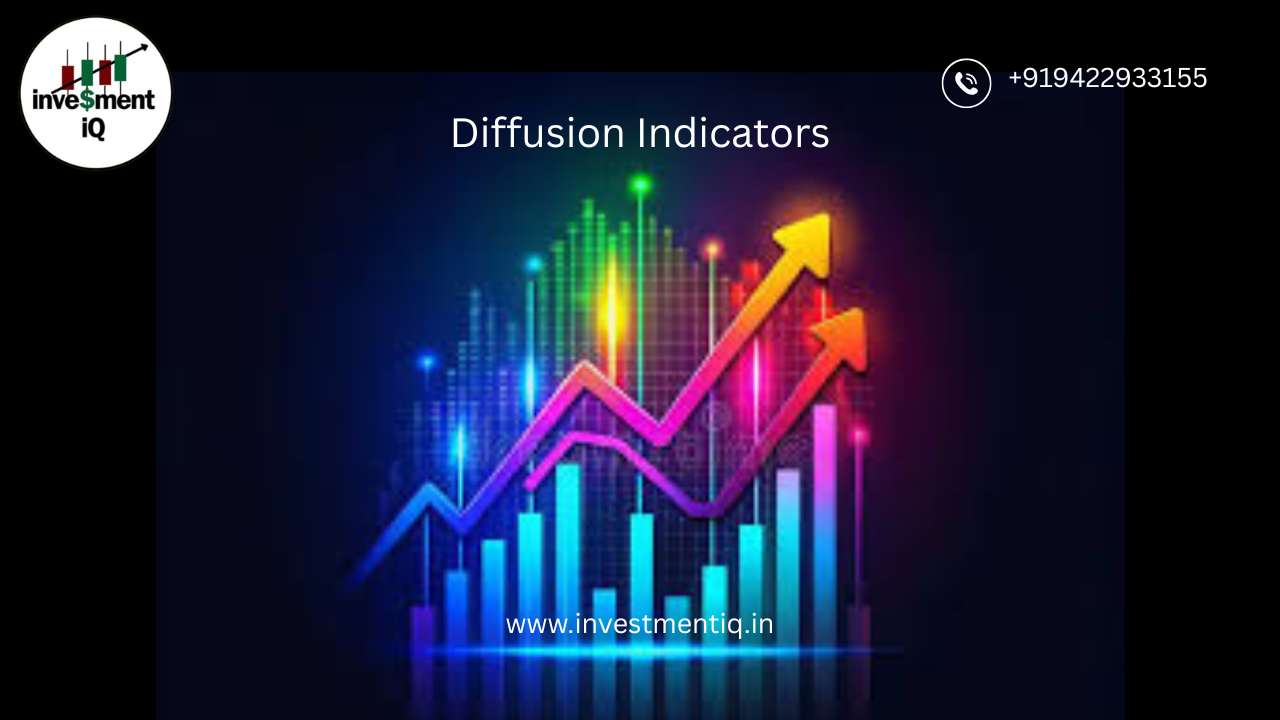
"Diffusion Indicators help traders assess market momentum by measuring how many assets are moving in the same direction."

Diffusion Indicators

Diffusion Indicators A family of breadth oscillators for different securities collections, such as currencies, commodities, and key indexes. Finding out how many securities in a basket are responding favorably is the goal. The more of those there are, the more overbought the situation is  and the more likely it is that the current trend will soon turn around. On the other hand, a bullish factor is a small number of securities in a favorable  trend. The Dow Diffusion Indicator The Emerging Markets Diffusion Indicator The European Diffusion Indicator The Global Diffusion Indicator The Dollar (Currency) Diffusion Indicator…

Continue ReadingDiffusion Indicators
Read more about the article Percent Above Moving Average
Monitor the percentage of stocks trading above their moving averages to evaluate overall market trend strength.

Percent Above Moving Average

Percent Above Moving Average The percentage of stocks above a given moving average is shown by a breadth oscillator. Percentage of Stocks Above a Moving Average: Internal Market Strength or Weakness It would be useful to know whether there is internal strength supporting an index's continued upward trajectory. One market breadth indicator that may be used to gauge the internal strength or weakness of an underlying index is the proportion of stocks that are trading above a particular moving average. The percentage of companies trading above the 50-day moving average is useful for short-to-medium-term timeframes. It's better to examine the proportion of companies trading above the 150- and 200-day moving averages for medium- to long-term periods. Bullish/bearish divergences, overbought/oversold levels, and crossovers above/below 50% can all provide trading indications.For the Dow, Nasdaq, Nasdaq 100, NYSE, S&P 100, S&P 500, and S&P/TSX Composite, the indicator is accessible. The percentage of stocks over their 50-, 150-, or 200-day moving averages can be plotted by users of SharpCharts. This article ends with a complete list of symbols. Calculating Percentage Above MA Copy (number…

Continue ReadingPercent Above Moving Average