Read more about the article The Pre-Holiday Effect
Analyzing the Pre-Holiday Effect in stock market behavior and investment trends.

The Pre-Holiday Effect

The Pre-Holiday Effect There have been nine holidays in the last century when the Exchanges have customarily closed. Historical research shows that stock prices often behave in a specific manner in each of the two trading days preceding these holidays. By becoming aware of…

Continue ReadingThe Pre-Holiday Effect
Read more about the article Sector Rotation Analysis
"Sector Rotation Analysis helps investors shift capital into sectors likely to outperform in different phases of the economic cycle."

Sector Rotation Analysis

Sector Rotation Analysis Based on the relative performance of the eleven S&P Sector SPDR ETFs, Sector Rotation Analysis aims to connect the stock market's current strengths and weaknesses with the overall business cycle. Once the strong and weak sectors have been determined, you may compare the results to a theoretical business cycle chart to potentially identify the market's business cycle stage. You may then use that information to forecast which industries will have the most growth in the upcoming weeks and months. The Business Cycle Sector Rotation Analysis Stage 1 shows the economy contracting and bonds turning up as interest rates decline. Economic weakness favors loose…

Continue ReadingSector Rotation Analysis
Read more about the article Bottom Fisher
Discover how Pring's Bottom Fisher helps traders identify potential market bottoms and reversal opportunities.

Bottom Fisher

Bottom Fisher A market momentum indicator designed to help identify market bottoms. Introduction It should go without saying that a market's greatest potential emerges immediately following its lowest point. This happens when the momentum of all the constituents in a market average or any series with many components shifts from a downward trend below zero to a downward trend below zero. The change from the "winter" to the "spring" posture in Figure 1 symbolizes this. In this instance, momentum could be shown by a ROC or an RSI. However, a smooth momentum series, like a MACD or stochastics, is ideal since we are looking for a series that provides a somewhat intentional shift of direction. The Bottom Fisher actually makes use of the KST. Figure 1 The difference between the number of Dow stocks with short-term (daily) KSTs in the winter and spring positions, respectively, is used to compute the Bottom Fisher.The indicator decreases when more and more groups encounter winter as opposed to spring.The indicator bottoms and a purchase signal is produced when this divergence begins to reverse  upward. To ensure that fluctuations in the indicator match those of the Dow, S&P, or any other market average to which it is being compared, the real data is shown inversely. The indicator must drop to one of the oversold levels shown in Chart 1 and then reverse for a reversal to be considered. As demonstrated by the May 2012 signal in the chart below, these indications are typically dependable but far from flawless. Waiting for a positive MA crossing of the!PRBFISH is therefore a more cautious strategy. In this instance, a 10-day SMA is the MA in use. Nevertheless, reversals that form at or below the 11 oversold level are typically slow and intentional, with minimal false upside reversals. Chart…

Continue ReadingBottom Fisher
Read more about the article How to Pick a Timeframein-2026
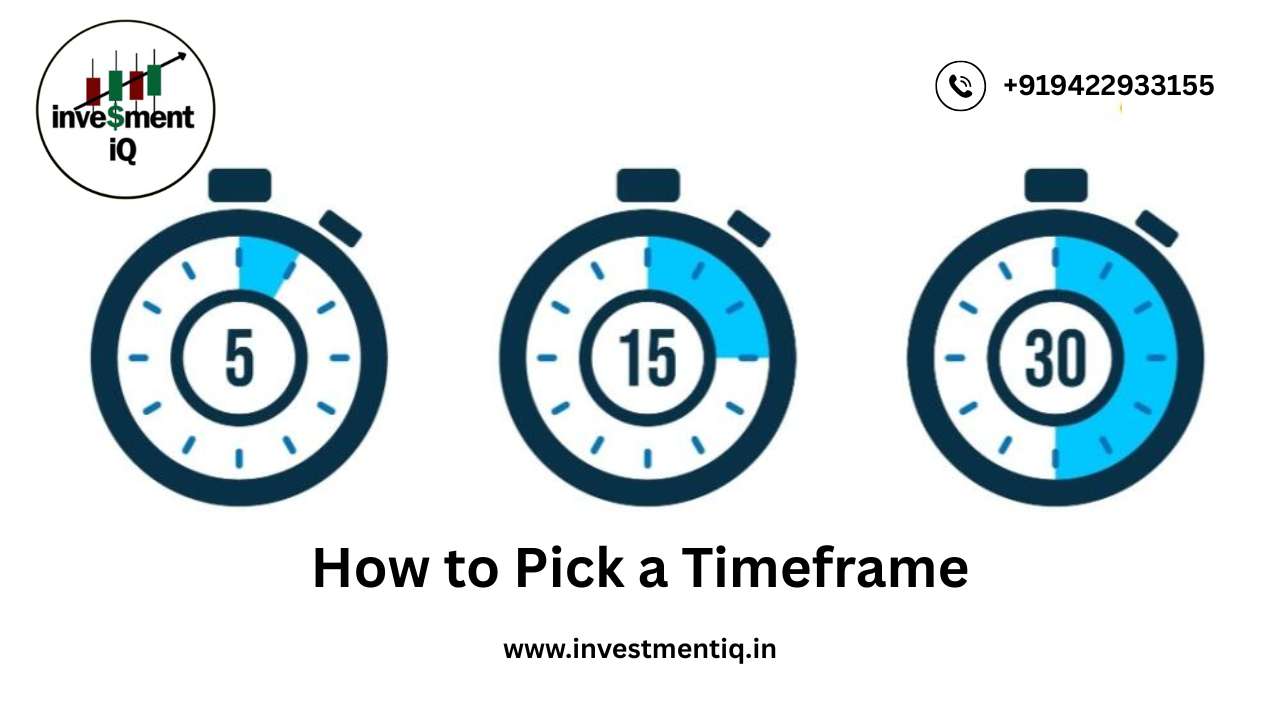
⏱️ Struggling to choose the right trading timeframe? Whether you're a day trader, swing trader, or long-term investor — your success starts with the right chart! 📊

How to Pick a Timeframein-2026

How to Pick a Timeframe The timeframe for creating a chart depends on the compression of the data—intraday, daily, weekly, monthly, quarterly, or annual. The less compressed the data, the…

Continue ReadingHow to Pick a Timeframein-2026
Read more about the article Balance of Power (BOP)
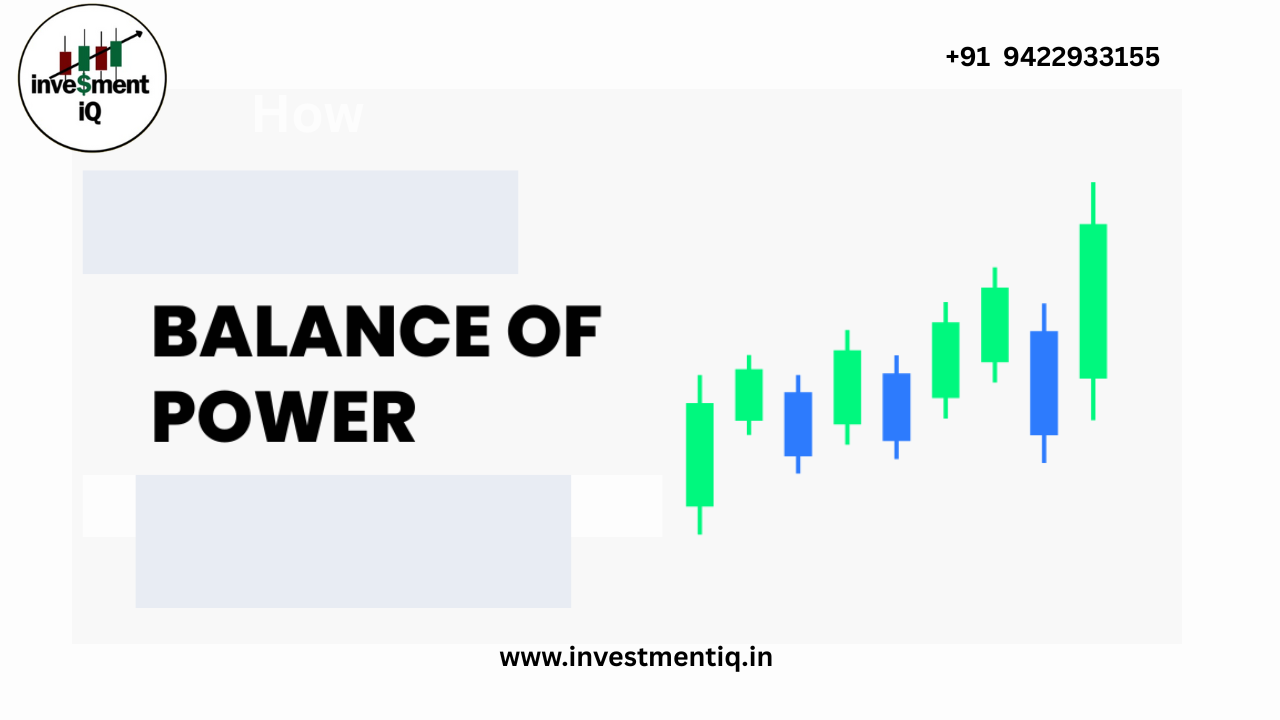
"Balance of Power (BOP) is a technical analysis tool used to assess the control of buyers vs sellers — learn more at InvestmentIQ.in"

Balance of Power (BOP)

What Is the Balance of Power? An oscillator called the Balance of Power (BOP) gauges how much pressure there is to purchase and sell. In the August 2001 issue of Technical Analysis of Stocks & Commodities magazine, Igor Levshin introduced this indicator, which contrasts the ability of sellers to drive prices to lower extremes with the ability of purchasers to drive prices to higher extremes. Bulls are in control when the indicator is in positive area, while sellers are in control when it is in negative territory. A value close to the zero line suggests equilibrium between the two and may signal a reversal of the trend. Note: This indicator is sometimes referred to as the Balance of Market Power (BMP). Calculation Livshin's original calculation method for…

Continue ReadingBalance of Power (BOP)
Read more about the article Fundamental Analysis
"📚 Want to know a company's real worth? Dive into fundamental analysis and make informed investment decisions based on data, not just price charts."

Fundamental Analysis

What is Fundamental Analysis? Fundamental analysis looks at the underlying factors that influence the health of businesses, industry associations, and the economy. The objective is to foresee future price fluctuations and make money from them, as is the case with most analysis. Learn in details about technical Analysis; here is our series about technical Analysis Fundamental analysis at the corporate level may entail looking at management, financial data, business concepts, and competition. The forces of supply and demand for the items offered may be examined at the industrial level. Fundamental analysis of the national economy may concentrate on economic statistics to evaluate the economy's growth, both now and in the future. In order to determine a stock's current fair value and project its future worth, fundamental analysis integrates economic, industry, and corporate study. Fundamental experts think that the stock is either overpriced or underpriced if fair value is less than the present price, and that the market price will  eventually move closer to fair value. Fundamentalists think that markets are weak-form efficient and disregard the random walkers' recommendations. Fundamental analysts seek out opportunities to profit from apparent price disparities because they think that prices do not fairly represent all a vailable information. What is…

Continue ReadingFundamental Analysis
Read more about the article Put/Call Ratio
"The Put/Call Ratio gauges investor sentiment by comparing the volume of put options to call options traded."

Put/Call Ratio

What Is the Put/Call Ratio? An indicator that displays put volume in relation to call volume is the put/call ratio. Put options are used to wager on a decline or to protect against market weakness.You can wager on an advance or hedge against market strength with call options. When put volume surpasses call volume, the put/call ratio is greater than 1, and when call volume surpasses put volume, it is less than 1. This indicator is usually used to measure the mood of the market.When the Put/Call Ratio is trading at relatively high levels, sentiment is considered overly negative; when it is trading at relatively low levels, sentiment is considered excessively positive.To smooth the data and extract signals, chartists can use moving averages and other indicators. Calculating the Put/Call Ratio The calculation is straightforward and simple.Copy Put/Call Ratio = Put Volume / Call Volume Options Exchanges Chicago Board Options Exchange (Cboe) Put/Call Ratios are available for research on StockCharts.com.The largest options exchange is Cboe, and its statistics are the most extensively used.The options are divided into three categories by the Cboeindicators: equity, index, and total.Options traded…

Continue ReadingPut/Call Ratio
Read more about the article Decision Point Intermediate-Term Breadth Momentum Oscillator (ITBM)
Learn how the ITBM reveals intermediate-term market momentum and breadth strength using DecisionPoint's trusted methodology.

Decision Point Intermediate-Term Breadth Momentum Oscillator (ITBM)

Decision Point Intermediate-Term Breadth Momentum Oscillator (ITBM) Compared to the shorter-term McClellan Oscillator, the ITBM provides a distinct viewpoint on breadth. Carl Swenl in created the Intermediate Term Breadth Momentum Oscillator (ITBM) to offer an alternative viewpoint for interpreting the McClellan  Oscillator. This indicator is computed using the Ratio-Adjusted version of the McClellan Oscillator. Welcome to Part our Technical Analysis 101 Series – “Dominate the Markets with Smart Technical Analysis”! Calculating…

Continue ReadingDecision Point Intermediate-Term Breadth Momentum Oscillator (ITBM)
Read more about the article Strengths of Fundamental Analysis
Explore how fundamental analysis uncovers a company’s true value using financial health, earnings, and economic data.

Strengths of Fundamental Analysis

Strengths of Fundamental Analysis Long-term Trends For long-term investments based on extremely long-term patterns, fundamental analysis works well. Patient investors who choose the appropriate sector groups or companies can gain from the ability to see and forecast long-term changes in the economy, population, technology, or consumer behavior. Learn more about this Value Spotting Finding businesses that offer high value will be made easier with the aid of sound basic analysis. Some of the most renowned investors have a long-term and value-oriented perspective. John Neff, Warren Buffett, and Graham and Dodd are regarded as value investing evangelists. Companies with significant assets, a solid balance sheet, consistent earnings, and longevity can be found with the aid of fundamental research. Business Acumen One of the most obvious, but less tangible, rewards of…

Continue ReadingStrengths of Fundamental Analysis
Read more about the article What is Lagging Indicators
📉 What Are Lagging Indicators? Lagging indicators help confirm trends after they form, giving you reliable entry and exit signals. 📊 Learn when to use them with smart trading strategies at www.investmentiq.in #LaggingIndicators #StockMarketEducation #TechnicalAnalysis #investmentiQ #SmartTrading

What is Lagging Indicators

Lagging indicators, often known as trend-following indicators, do exactly what their name suggests: they track the price activity. These signs will almost never drive a security's price. When stocks or markets exhibit robust trends, trend-following indicators perform well. As long as the trend continues, they are intended to draw traders in and hold them there. As a result, these indicators are useless in sideways or trading markets. Trend-following indicators are likely to produce a lot of false signals and whipsaws when employed in trading markets. MACD and moving averages (exponential, basic, weighted, and variable) are two common trend-following indicators. The S&P 500 ($SPX) is seen in the above chart along with its 20- and 100-day simple moving averages. Seven signals were produced during the two years shown in the figure using a moving average crossover. The system would have made a huge profit throughout these two years. The significant trends that emerged from October 1997 to August 1998 and from November 1998 to August 1999 are to blame for this. Observe, however, that the whipsaws commence as soon as the index begins to move laterally within a trading range. Within a few days, the purchase, sell, and sell signals in November 1997, August 1999, and September 1999 were reversed. There would have been fewer whipsaws if these moving averages (50- and 200-day moving averages) had been longer.Had these moving averages been shorter (10 and 50-day moving average), there would have been more whipsaws,…

Continue ReadingWhat is Lagging Indicators