Read more about the article Detrended Price Oscillator (DPO)-2025
"The Detrended Price Oscillator (DPO) is used to remove long-term trends and highlight short-term cycles. Learn how to use it on InvestmentIQ.in"

Detrended Price Oscillator (DPO)-2025

What Is the Detrend Price Oscillator (DPO)? An indicator called the Detrended Price Oscillator (DPO) was created to separate price trend and facilitate cycle identification. Since DPO is based on a displaced moving average, it does not extend to the latest date. However, since DPO is not a momentum oscillator, alignment with the most recent date is not a problem. Rather, cycle length is estimated and cycle highs and lows are identified using DPO. Calculation Copy Price {X/2 + 1} periods ago less the X-period simple moving average. X refers to the number…

Continue ReadingDetrended Price Oscillator (DPO)-2025
Read more about the article PMO Configurations-2025
"Explore the best PMO (Price Momentum Oscillator) configurations for 2025 to fine-tune your market analysis – from InvestmentIQ.in"

PMO Configurations-2025

PMO Configurations Sideways Wiggle A typical PMO formation is seen in the accompanying chart, which highlights the fact that not all PMO crossover signals may be interpreted literally. PMO movement during a consistent upward price trend is represented by the red-circled area. The PMO travels horizontally since the price movement is not very volatile. The fact that the PMO remains above the zero line testifies to the strength of the price move; however, minor zigzags in price…

Continue ReadingPMO Configurations-2025
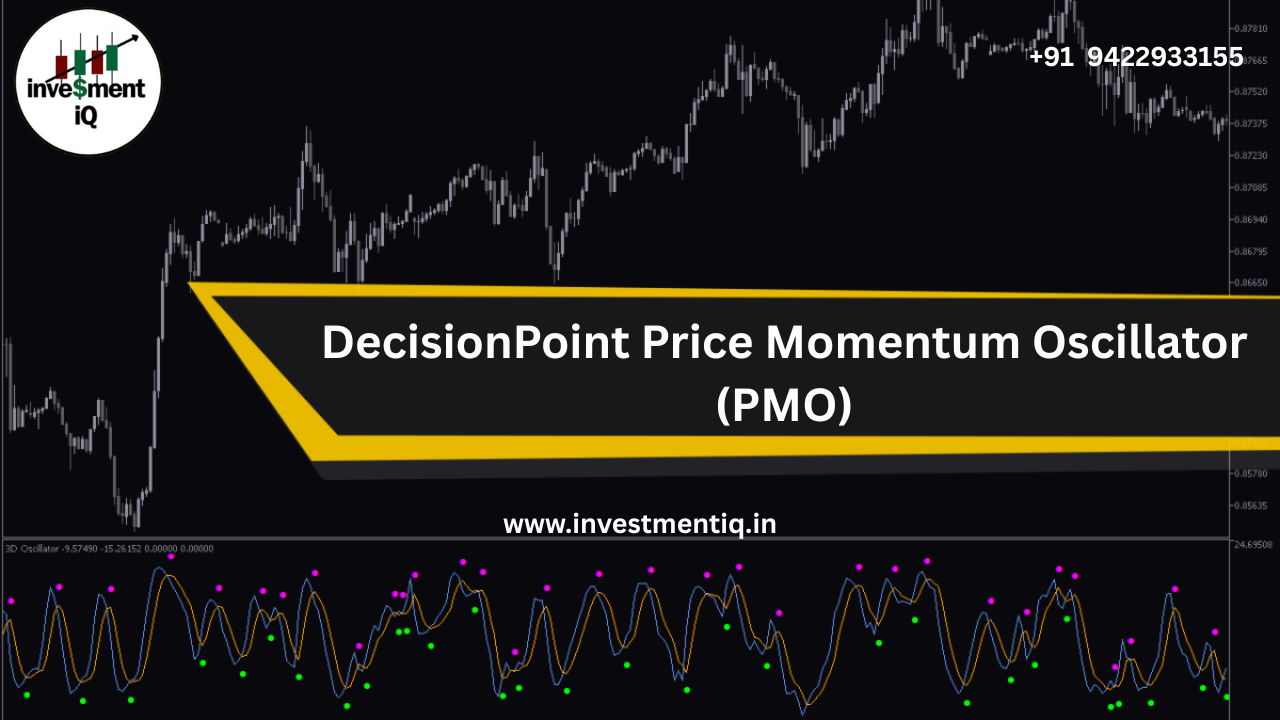
Read more about the article DecisionPoint Price Momentum Oscillator (PMO) in-2025
"The DecisionPoint Price Momentum Oscillator (PMO) helps traders measure price momentum and identify potential trend reversals – Learn more at InvestmentIQ.in"

DecisionPoint Price Momentum Oscillator (PMO) in-2025

DecisionPoint Price Momentum Oscillator (PMO) The DecisionPoint Price Momentum Oscillator (PMO), created by Carl Swenlin, is an oscillator that is based on a Rate of Change (ROC) calculation that has been twice smoothed using exponential moving averages and a specially designed smoothing procedure. The PMO can also be used as a relative strength tool because it is normalized. Stocks can thus be ranked by their PMO value as an expression of relative strength. Calculating the PMO A 1-period rate of change is smoothed using two bespoke smoothing methods to produce the DecisionPoint Price Momentum Oscillator. Although the custom smoothing algorithms are quite similar to Exponential Moving Averages, they just use the period by itself rather than adding one to the time period option to create the smoothing multiplier (as in a real EMA).A copy Smoothing Multiplier =…

Continue ReadingDecisionPoint Price Momentum Oscillator (PMO) in-2025
Read more about the article CMB Composite Index
"The CMB Composite Index is a tool that combines multiple indicators to evaluate market trends – explore its components on InvestmentIQ.in"

CMB Composite Index

What Is the CMB Composite Index? Constance Brown first presented the CMB Composite Index, an unbound momentum indicator, in her book Technical Analysis for the Trading Professional. The traditional RSI indicator, created by Welles Wilder, had several drawbacks that this updated version of RSI aims to address. First, Brown's signal now includes a momentum component, which Wilder's version does not. Brown also decided to turn the CMB Composite Index into an unbound indicator. Some reversal indications may be missed by traditional RSI because of its restricted character. Brown recommends looking for divergences between the CMB Composite Index and traditional RSI, which can indicate an upcoming reversal.…

Continue ReadingCMB Composite Index
Read more about the article Average True Range (ATR) and Average True Range Percent (ATRP) in-2025
"Visual representation of Average True Range (ATR) and ATR Percent (ATRP) – tools for measuring market volatility on InvestmentIQ.in"

Average True Range (ATR) and Average True Range Percent (ATRP) in-2025

What Is the Average True Range (ATR)? The Average True Range (ATR) is a volatility indicator that was created by J. Welles Wilder. Wilder created ATR with commodities and daily prices in mind, as he did with the most of his indicators. Compared to equities, commodities are sometimes more volatile. They frequently experience gaps and limit moves, which happen when a commodity opens up or closes below the session's maximum permitted  change. The volatility of gap or limit moves would not be captured by a volatility model that solely relies on the high-low range. In order to account for this "missing" volatility, Wilder developed the Average True Range. It is important to remember that ATR doesn't indicate price direction, just volatility.In his 1978 book, New Concepts in Technical Trading Systems, Wilder discusses ATR. The Directional Movement Concept (ADX), RSI, and Parabolic SAR are also included in this book. Wilder's indications have endured and are still widely used even though they were created before the computer era. True…

Continue ReadingAverage True Range (ATR) and Average True Range Percent (ATRP) in-2025
Read more about the article Technical Indicators & Overlays
📈 Want to level up your chart analysis? Learn how to use indicators like RSI & MACD and overlays like moving averages to spot trends, momentum, and entry points. 🎯

Technical Indicators & Overlays

Technical Indicators & Overlays Introduction Technical Indicators are the often squiggly lines found above, below and on-top-of the price information on a technical chart. Indicators that use the same scale…

Continue ReadingTechnical Indicators & Overlays
Read more about the article Dominate the Markets with Smart Technical Analysis | TA 101 – Part 17
Level up your technical analysis game in TA 101 Part 17. Learn advanced signals and smarter trading strategies to stay ahead of the market!

Dominate the Markets with Smart Technical Analysis | TA 101 – Part 17

Dominate the Markets with Smart Technical Analysis | TA 101 – Part 17 Smart Technical Analysis Comparison Charting Welcome to Part our Technical Analysis 101 Series – "Dominate the Markets…

Continue ReadingDominate the Markets with Smart Technical Analysis | TA 101 – Part 17
Read more about the article Dominate the Markets with Smart Technical Analysis-TA 101 – Part 7
🚀 Part 7 of TA 101 is here! Master the next level of Technical Analysis and start thinking like a pro trader. 📈 Trend Strength 🔍 Volume Confirmation 📊 Advanced Price Patterns Learn how to dominate the market with smarter strategies. #TradingSkills #TechnicalAnalysis #TA101 #StockMarketEducation #SmartTrading

Dominate the Markets with Smart Technical Analysis-TA 101 – Part 7

Chart Analysis - Support and Resistance Technical Analysis Fear and greed, two of humanity's most powerful emotions, influence prices. A stock drops when more investors are afraid it will! Until…

Continue ReadingDominate the Markets with Smart Technical Analysis-TA 101 – Part 7